Convert US, UK and EU shoe sizes to Mondopoint with our ski boot size chart, plus the +18 rule and how a beginner ski boot should fit.


Lorem ipsum dolor sit amet, consectetur adipiscing elit proin mi pellentesque lorem turpis feugiat non sed sed sed aliquam lectus sodales gravida turpis maassa odio faucibus accumsan turpis nulla tellus purus ut cursus lorem in pellentesque risus turpis eget quam eu nunc sed diam.
Lorem ipsum dolor sit amet, consectetur adipiscing elit proin mi pellentesque lorem turpis feugiat non sed sed sed aliquam lectus sodales gravida turpis maassa odio.
Lorem ipsum dolor sit amet, consectetur adipiscing elit consectetur in proin mattis enim posuere maecenas non magna mauris, feugiat montes, porttitor eget nulla id id.
Lorem ipsum dolor sit amet, consectetur adipiscing elit ut suspendisse convallis enim tincidunt nunc condimentum facilisi accumsan tempor donec dolor malesuada vestibulum in sed sed morbi accumsan tristique turpis vivamus non velit euismod.
“Lorem ipsum dolor sit amet, consectetur adipiscing elit nunc gravida purus urna, ipsum eu morbi in enim”
Lorem ipsum dolor sit amet, consectetur adipiscing elit ut suspendisse convallis enim tincidunt nunc condimentum facilisi accumsan tempor donec dolor malesuada vestibulum in sed sed morbi accumsan tristique turpis vivamus non velit euismod.
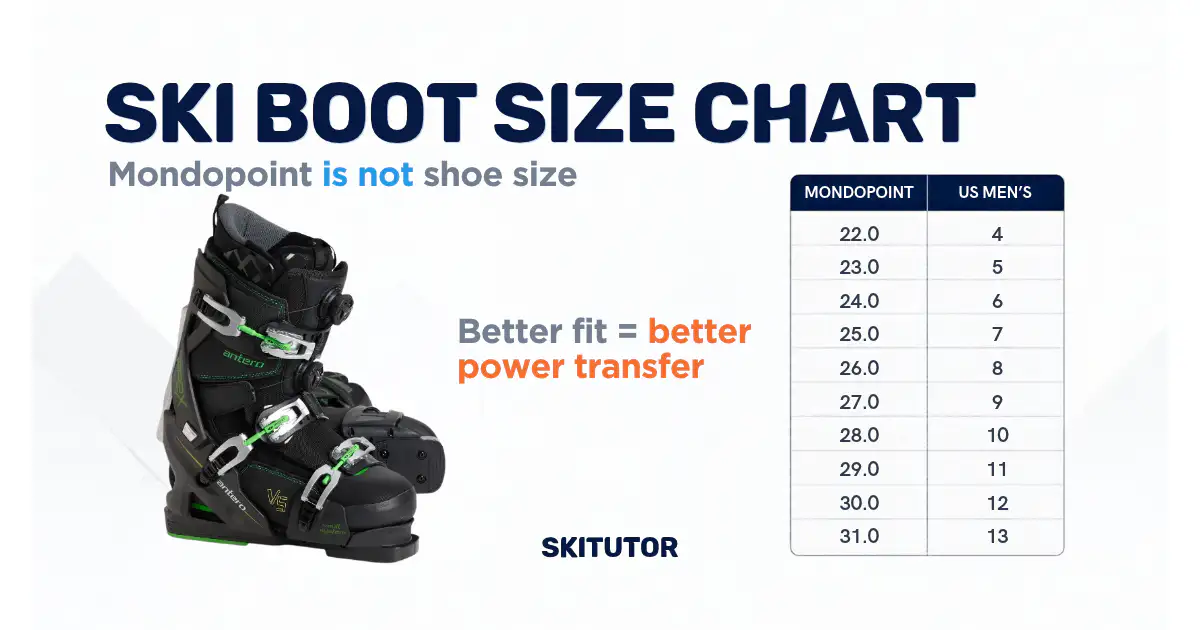
Your ski boot size is your foot length in centimeters. In skiing, we call that size "Mondopoint." As a rough guide, it works out to about your US men's shoe size + 18, or your US women's size + 17. A men's 9 is a 27. A women's 8 is a 25.
That shortcut gets you close, but it won't be exact. Sizing varies slightly by manufacturer. Plus, I strongly encourage you to work with a boot fitter.
Below are 3 helpful items. First, adult and kids' size charts. Second, how to measure at home. Third, what beginner boots should feel like.
Find your measured foot length or your street shoe size, then read across. Standard fit is in the left column for beginner or intermediate skiers. Performance fit is one full Mondopoint size shorter. Advanced skiers often choose this option, usually with a boot fitter's help.
| Mondopoint (standard fit) | Foot length (in) | US men's | US women's | UK | EU | Mondopoint (performance fit) |
|---|---|---|---|---|---|---|
| 22 | ~8.7 | 4 | 5 | 3 | 35 | 21 |
| 22.5 | ~8.9 | 4.5 | 5.5 | 3.5 | 36 | 21.5 |
| 23 | ~9.1 | 5 | 6 | 4 | 36.5 | 22 |
| 23.5 | ~9.3 | 5.5 | 6.5 | 4.5 | 37 | 22.5 |
| 24 | ~9.4 | 6 | 7 | 5 | 38 | 23 |
| 24.5 | ~9.6 | 6.5 | 7.5 | 5.5 | 38.5 | 23.5 |
| 25 | ~9.8 | 7 | 8 | 6 | 39 | 24 |
| 25.5 | ~10.0 | 7.5 | 8.5 | 6.5 | 40 | 24.5 |
| 26 | ~10.2 | 8 | 9 | 7 | 40.5 | 25 |
| 26.5 | ~10.4 | 8.5 | 9.5 | 7.5 | 41 | 25.5 |
| 27 | ~10.6 | 9 | 10 | 8 | 42 | 26 |
| 27.5 | ~10.8 | 9.5 | 10.5 | 8.5 | 42.5 | 26.5 |
| 28 | ~11.0 | 10 | 11 | 9 | 43 | 27 |
| 28.5 | ~11.2 | 10.5 | 11.5 | 9.5 | 44 | 27.5 |
| 29 | ~11.4 | 11 | 12 | 10 | 44.5 | 28 |
| 29.5 | ~11.6 | 11.5 | - | 10.5 | 45 | 28.5 |
| 30 | ~11.8 | 12 | - | 11 | 45.5 | 29 |
| 30.5 | ~12.0 | 12.5 | - | 11.5 | 46 | 29.5 |
| 31 | ~12.2 | 13 | - | 12 | 47 | 30 |
| 31.5 | ~12.4 | 13.5 | - | 12.5 | 47.5 | 30.5 |
| 32 | ~12.6 | 14 | - | 13 | 48 | 31 |
Chart values are from October 2026 using Nordica, Tecnica, and evo. EU shoe sizes vary by about half a size between brands, so treat that column as a guide.
Two things to notice. First, women's boots run one US size "smaller" on the same Mondopoint. A women's 8.5 and a men's 7.5 are both a 25.5. Second, many brands make one shell for two Mondopoint sizes. A 26.0 and a 26.5 often share the hard-plastic shell but have slightly different liners. Going up half a size may change less than you'd expect.
Kids' conversions disagree even more than adults'! evo and Rossignol assign the same 15.5 Mondopoint to a kids' 8 and a kids' 9.5. That's a size and a half apart. For kids, measure the foot. Don't convert shoe sizes.
| Mondopoint (cm) | Foot length (in) | US kids' size (evo) | US kids' size (Rossignol) |
|---|---|---|---|
| 15.5 | ~6.1 | 8 | 9.5 |
| 16.5 | ~6.5 | 9 | 10.5 |
| 17.5 | ~6.9 | 11 | 11.5 |
| 18.5 | ~7.3 | 12 | 12.5 |
| 19.5 | ~7.7 | 13 | 13.5 |
| 20.5 | ~8.1 | Youth 1 | - |
| 21.5 | ~8.5 | Youth 3 | - |
Don't buy a boot a size up so your child can grow into it. A foot that slides around inside the shell can't steer the ski, and a kid who can't steer has a miserable first day. If growth is the worry, a season-long kids' rental program is the usual answer.
Nordica, Tecnica and evo's help center agree row for row: Mondopoint = US men's size + 18 = US women's size + 17. That's the rule behind the chart above.
evo's own sizing guide, though, lists each men's size as half a size larger than evo's help center does.
| US men's | Nordica | Tecnica | evo help center | evo sizing guide |
|---|---|---|---|---|
| 7 | 25 | 25 | 25 | 25.5 |
| 8 | 26 | 26 | 26 | 26.5 |
| 9 | 27 | 27 | 27 | 27.5 |
| 10 | 28 | 28 | 28 | 28.5 |
Neither chart is wrong, exactly. Shoe sizes aren't standard across brands, so every conversion is an approximation. Mondopoint is a single number that has the same meaning everywhere. It’s simply a way to measure. That's why the tape measure beats the chart.
You need a sheet of paper, a pencil, a ruler and a wall. Do this in the evening, when your feet are at their largest.
A US women's 6.5 or a men's 5.5 (UK 4.5, EU 37). Foot length ~9.25 inches.
A US women's 7.5 or a men's 6.5 (UK 5.5, EU 38.5). Foot length ~9.65 inches.
A US men's 7.5 or a women's 8.5 (UK 6.5, EU 40). Foot length ~10 inches.
A US men's 8.5 or a women's 9.5 (UK 7.5, EU 41). Foot length ~10.4 inches.
A US men's 9.5 or a women's 10.5 (UK 8.5, EU 42.5). Foot length ~10.8 inches.
Buy at your measured length, and expect it to feel snug. A new boot that feels comfortable in the shop can feel loose after a few days on snow. The liner packs out over the first few days of skiing, so a boot that starts snug ends up right.
Here's what "right" feels like when you try one on:
The shop's best test is a shell check. They pull the liner out, you slide your foot into the bare plastic shell until your toes touch the front, and they measure the gap behind your heel. One to one and a half fingers (~15 to 22 mm) is a good fit. More than two fingers is too big.
The most common beginner mistake is sizing up because the right boot feels tight. Don't. A loose boot lets your foot slide, and a sliding foot can't control the ski. Boots are what make or break your first lesson, so this matters more than any other gear choice.
For reference, I wear a 10 to 10.5 street shoe, which the chart puts at a 28 to 28.5. I ski a 26.5 Lange RX 100 that I've had since 2018. That's a size and a half to two sizes shorter than the chart, which is where many advanced skiers end up once a boot fitter gets involved. Don't copy that on your first pair. Start at your measured length.
Length gets you the right size. Width, called the last, decides whether the boot is comfortable. It's measured across the forefoot in millimeters.
| Last | Forefoot width | Best for |
|---|---|---|
| Narrow | 97 to 98 mm | Narrow feet, advanced skiers who want precision |
| Average | ~100 mm | Most feet |
| Wide | 102 to 106 mm | Wide feet, most beginner and comfort boots |
Most beginner boots sit at 100 mm or wider, which is what you want. If your foot is wide, check the last before you buy online. A boot in the right length but the wrong width will hurt in exactly the same way as a boot that's too short.
Look at the heel of any ski boot, and you'll see a number in millimeters, like 305 mm. That's the boot sole length, or BSL. It's the length of the outside of the plastic shell, and it's what a shop uses to adjust your bindings.
BSL and Mondopoint are not the same number. A 26.5 boot does not have a 265 mm sole. Because two sizes often share a shell, a 26.0 and a 26.5 usually have the same BSL, and it varies by brand and model.
You'll need your BSL when you set up bindings. It's one of the inputs to your DIN setting, along with your weight, height, age and skill level.
At the rental counter, give them your measured Mondopoint, not your shoe size. Rental fleets carry a limited set of shells, and on a busy morning you may be handed a boot that's a little big. If yours feels loose when you flex forward, ask for a half size down before you leave.
Boots are the one piece of gear you should own first. Skis rent fine. Boots that have molded to your feet over a few days do not. If you're weighing renting vs. buying, boots are the better buy. They connect your body to the skis.
Neither, exactly. Ski boots use a different scale. Your Mondopoint is roughly your US men's size + 18 or women's size + 17. Measure your foot to be sure.
Snug, not painful. Your toes should lightly brush the front when you stand straight and pull back when you flex forward. Boots loosen over the first few days as the liner packs out.
Stand on paper with your heel against a wall, wearing ski socks. Mark your longest toe and measure in centimeters. Use the longer of your two feet.
No. A loose boot can't steer the ski. Buy for the foot your child has now, or use a season-long rental.
Often yes, at least for the shell. Many brands use one shell for both sizes and change only the liner. Check the boot sole length on the heel. If it's the same, so is the shell.
You now know more about boot sizing than most people standing in a rental line. Measure both feet tonight in your ski socks, and write down the longer number. That's your Mondopoint. Take it to a shop, or use it to compare beginner ski boots, and buy that length in a last that matches your foot.